November has always been my least favorite month, and this year has not provided any exception. After a jam-packed August, September, and October fueled by the momentum that only comes with being new to a city, country, and culture, I crashed. I had been warned that my first several months here would be hampered by unshakeable illness due to the pollution and constant exposure to germy children. But after making it through the first few months with nothing more than a short-lived cold, I thought I had gotten off scot-free. November came to prove me wrong with a vengeance.
Plagues of interminable mucus, an incessant cough, several bouts of cold and flu bugs, and insomnia left me lethargic and fatigued. This understandably resulted in an excruciatingly lackluster month in which I did little more than rest and mope. Not until the end of the month was I able to do anything more notable than having several movie marathons or buying a down coat in preparation for the ill-reputed yet seemingly non-existent Korean winter. And after a visit to a Korean doctor procured an x-ray reminiscent of a smoker’s lung, I floated around in a haze of several rounds of varying prescription and over-the-counter drugs, both Korean and American, until my hacking was reduced to a much more tolerable light cough. Luckily, the worst of it seems to be over with November finally coming to a close and Christmas in sight.

Monday, November 29, 2010

Yogification
Being a dancer, I always thought yoga would be a good fit. But in the US yoga is trendy and thus it’s expensive, so I never wanted to fork over the money to find out whether or not I liked it. But in Korea, where trendy doesn’t equal expensive, it’s a different story. Here, yoga is actually absurdly cheap (as long as it’s not Bikram yoga) despite its popularity. So I figured now was a great time to see if my suspicions about yoga were correct.
Within a few weeks of arriving here, I joined Prana Yoga Studio just two blocks down the street and instantly became an addict. (At $2 a class, it’s hard not to be!) Within a week I was already a regular at the 7:00 class taught daily by Chin, an adorable Korean woman with an endearing personality and English word bank of about 30 words. She also quickly took a liking to me, I think partly because I was one of three foreigners in the class (now one of one) and partly because she mistook my God-given gumbi-ness and dance-endowed body placement for yoga expertise. Even after discovering that I’m no veteran yoga-goer, made clear by my pitiful balance and the fact that I’m hopeless when it comes to deep breathing, she has set the bar high.
From day one Chin has been nothing short of persistent in challenging me to build my yoga prowess. She is unrelenting in her battle to get me to breathe properly, informs me regularly that I need to do lots of sit ups in my spare time (often using the entire class’s English abilities to stage this conversation), and encourages me into all the pretzel-like poses that no one else is willing to attempt, all the while asking “You are ok? You are ok?” We have definitely had moments where she pushed me into some position so bizarre or abnormal that I simply had to laugh, my limbs bent in ways they definitely shouldn’t be. With her help, I have finally conquered the rooster, embryo in womb, supported headstand, and final asanas, all of which my body had stubbornly rejected for the first 2 months or so. All of this has earned me one of the coveted spots in the front of the class.
Yes, the language barrier poses some obstacles, but I’ve memorized the general routine and can pick up most variations from watching. Plus, if I can’t figure out my body placement with the help of my 19 years of dance, Chin will come along and manhandle me into the proper position. I’ve also picked up on some Korean words. Something that sounds like “bashigo” is inhale, while exhale is something close to “daeshigo.” There’re also a handful of other terms that I won’t even try to spell but I at least recognize as cues to do various forms of stretching, breathing, or moving. Of course, there are always times when I am utterly lost in translation, like those times when Chin will give an instruction that makes no sense in the context – “point” and “jump” are very basic instructions but when I’m being told to point my hip or jump when I’m sitting on the floor I’m at a complete loss. I have yet to figure out the translation.
With all of the sweating and pretzeling I wouldn’t say yoga has been as relaxing as it’s cracked up to be. But even with the ratio of time spent relaxing to contorting being about one to three, the last 15 minutes of class are enough to shake off any of the stress and strain still clinging to me after a day with screaming children. I must admit, the defining moment of my whole yoga experience comes in these last 15 minutes when we simply lay on the heated floors under flannel blankets while Chin circulates amongst the class, dotting our noses with eucalyptus oil before commencing a brief but wonderful arm and chest massage.
With all of that, I always leave the studio feeling some combination of unwound, triumphant, exhausted, and content. And as Chin always offers her farewell of “Okaaay. Thank yooou. See you Monday!” (no matter what day it is) I never fail to leave smiling.
Wednesday, November 24, 2010
The precarious peninsula
The BBC calls the Korean peninsula “one of the world’s geo-political hotspots,” a categorization made quite clear yesterday when North and South Korea exchanged fire on the South Korean island of Yeonpyeong. It’s often easy to forget the precariousness of the situation on my peninsula of residence – taking for granted that right across the border, which is not all that far away, resides one of the world’s most elusive and ominous regimes. But it becomes hard to ignore when it shows up in my inbox; the subject lines of emails from the BBC, New York Times, and US Embassy in Seoul blaring “Artillery Firing into Northwest Islands off the Coast,” “Border Clash Prompts South Korean Missile Warning,” and “South Korea Scrambles Jets.”
Is this the beginning of round two of the Korean War, or is it just more of North Korea’s posturing? It’s probably too soon to tell, but I hope for the latter. As the New York Times so kindly points out, “A face-off on the Korean Peninsula would require tens of thousands of troops, air power and the possibility of a resumption of the Korean War, a battle that American officials believe would not last long, but might end in the destruction of Seoul if the North unleashed artillery batteries near the border.” Slightly unsettling.
Of course, this is not the first time North Korea’s threats have been brought to my attention - I signed my contract not long after a North Korean torpedo sank a South Korean navy ship, making “What about North Korea?” the first question everyone asked after I announced I was moving to Seoul. Nevertheless, it’s understandably disconcerting to have it pointed out on every media outlet that your place of residence, which happens to be the main target of a crazy military regime, could possibly be in imminent danger.
All that being said, there’s not much to do besides hope for the best, wait to see how things pan out, and take the necessary precautions (i.e. registering with the embassy, carrying a passport and cash, and having an exit strategy.)
For articles see the links below:
http://www.bbc.co.uk/news/world-asia-pacific-11823474
http://www.nytimes.com/2010/11/24/world/asia/24nkorea.html?_r=1&ref=global-home
http://www.kansascity.com/2010/11/23/2467305/obama-agrees-to-military-exercises.html
http://www.nytimes.com/2010/11/25/world/asia/25seoul.html?ref=global-home
Monday, November 1, 2010
Halloween shenanigans
Halloween has never been at the top of my list of favorite holidays, but I must say that this Halloween was above par – there’s nothing quite like celebrating Halloween festivities with a bunch of 6 year olds. It was a week-long event, with the holiday merriment including lots of Halloween art; a parent open-house with mummy wrapping, edible spider art, a monster mash walk, scary stories, and monster puppet-making; Halloween BINGO; jack-o-lantern carving; and goodie bag decorating; all culminating in pseudo trick-or-treating and a costume fashion show on Friday.
If the week itself wasn’t exhausting, Friday sure was. Finding ways to entertain costumed children who are overloaded on sugar is no easy feat. Luckily, my class’s costumes weren’t too over-the-top. In order to keep the boys from all coming as Spiderman and the girls from all being fairy princesses, classes get costume assignments. My class got “traditional costumes around the world.” (Mac people: don’t worry, I’m aware that this category crosses all sorts of PC lines.) We had costumes representing Japan, China, England, Switzerland, Mexico, and Native Americans along with a Robin Hood, Zoro and Snow White (who were relegated to the ranks of England, Mexico, and Germany, respectively). I was informed that my costume needed to be more than an accessory or two so I decided on Native American as my traditional costume of choice and ran with it. I must say, I really outdid myself, seeing as I’m neither crafty nor a Halloween fan, making my costume entirely out of felt, feathers, and hot glue.


Needless to say, I welcomed the weekend very enthusiastically, not to say that the Halloween celebrations ended at school. Inspired by the glasses donned by “hip Koreans,” Maria, Britney, and I decided to spend our Saturday as a Where’s Waldo trio in the foreigner district of Seoul, Itaewon (an area I usually avoid, but where better to celebrate this ridiculous holiday?) To our amusement, Waldo was a hit! By the end of the night we had been in dozens of photos with random people and had heard our fill of unoriginal Waldo comments (there’s only so many ways you can respond to “I found you!”) We thoroughly enjoyed our comfortable, popular, easily identifiable costumes and managed to make it until the subways started running again at 5:00am to avoid paying cab fare. Overall, I’d say the night was a success.

Big transitions
The most shocking part of being in Korea hasn’t been the food, the language, the cultural subtleties, or getting used to being a lone foreigner in a sea of Koreans. By now I’ve gotten over my foreigner self-consciousness, figured out a routine, and developed culturally acceptable habits in Korean etiquette. No, the hardest part of living in Korea hasn’t been Korea at all; it’s been the transition into the real world after a lifetime of being in school.
After seventeen years of the same routine, I find myself homework-less, stress free, generally rested, and totally lost. You would think that being free of deadlines, stress, and sleep deprivation would be a relief, but the transition requires a different gauge of fulfillment and success, grasp on time and energy, and perspective on productivity. It has totally thrown me for a loop. School is what I do, it’s what I’m good at, and it’s always been a big part of my identity. The switch from all-nighters, frequent twenty page papers, and daily discussions centering around the world’s most daunting questions to Disney sing-alongs, hours of cutting out construction paper, and discussing Halloween ghouls has been startling to say the least.
Not only am I adjusting to having a schedule that isn’t crammed with homework and studying (yes, it is an adjustment, believe it or not…what do I do with all this free time?!), I’m also getting used to post-grad loneliness. Our entire lives we are surrounded by companions (wanted or not), from our families to our classmates and teammates, and later, roommates. People who we know and share activities, experiences, and interests with have always been nearby. After graduation, especially after moving to a new place, this is no longer the case. Now, friends are spread across the city, working at different places, and doing different things (not to mention the friends who are elsewhere in the country or the world). Unlike my dorm-days when friends were almost too easily accessible, it can now take hours on public transport to meet someone, it takes some getting used to.
Of course, this transition is not specific to my living in Seoul, I’m sure I’d feel the same discomfort were I in any other city: Chicago, D.C., London, you name it. It may not be culture shock, but it’s been a shock to my system nevertheless.
Sunday, October 31, 2010
Kindie love

I spend the first four hours of every workday with K-blue class, a kindergarten class of 12 highly energetic, extraordinarily affectionate, over-eager, and often-exhausting Korean 6-year-olds. Every morning, I arrive at work at 10:00am after walking the two minutes from my apartment. I walk down the hall to the same scene every day: Jean peers around the door and yells back into the classroom, “Shelby Teacher is come!” while Lily skips out into the hall and Joseph jumps up and down. As I walk into the classroom, I am doggie-piled from all sides by kindergarteners as six or seven little bodies slam into me screaming, “SHELBY TEACHAAAAAARRRRRRRRR!!” “How is everyone today?” I ask, prying my kids off me. “HAPPY!” they respond. And so, my day starts. Yes, at work I’m “Shelby Teacher,” give or take some mispronunciations. Shell Teacher or Shel-buh Teacher are about as close as some of my little ones get. Although, because my kids are six and because Korean has a slightly whiney lilt to it already, it’s usually less “teacher” and more of a warbling “teachaaar.” From the beginning, though, I’ve been very happy to be Shelby Teacher and not Miss Fields, or some other title that feels far too adult and proper, the amount of respect I am given simply for being a teacher is alarming enough. (I’m not sure I’ll ever get used to parents nearly twice my age bowing to me.) But I digress…
I know I’m not supposed to have favorites but kindergarten is hands down my favorite class to teach. In kindergarten, the smiles abound. Not only am I given the leeway to be creative and teach what and how I wish, but my kindies are the sweetest, most affectionate, unconditionally loving group of children. Everyday I receive a year’s worth of hugs, love, and admiration. Joseph will shamelessly interrupt me with “Shelby Teachaar…I love you,” as I explain how question marks are used or quiz the class on their dictation words and Lily will always find ways to show her adoration, offering compliments like “Shelby Teacher is vaary pretty today, I think,” or “Shelby Teacher veeehry veehry smell good.” Not to mention the gifts. To date I have received numerous drawings, home-made cards and crafts, a cactus, an instant coffee gift-set, a whole pizza (unfortunately smothered in none other than mayonnaise), and a blueberry cake, all from eager six year-olds absolutely quivering with the excitement of giving their teacher tokens of their love. Kindergarten logic has not failed to amuse me. For example, they figure that if North America and South America are separate continents, then Africa and South Africa are surely separate continents since hosting the world cup clearly is an honor great enough to earn a country continental status. (I’ve quickly learned that Koreans are born and bred soccer fanatics. There’s rarely a day that passes without the mention of the World Cup, Park Ji-Seong, or Manchester United.) All silliness aside, their innocence six-year-old wisdom is always heart-warming. The week that we learned about great people of the world, Heidi very anxiously asked, "Teacher, if we no take care of world it is ouch?" We proceeded to put big words and concepts into kindie-speak; in all of their innocence, they remembered protest as “say NO!” and freedom as "people catch and no more catch, they go."
As for their curiosity, my class has made a point of finding out everything about me, every detail of which they remember and recite with pride when the opportunity arises. Joseph likes to interrogate me on my soccer knowledge (which is pitiful say the least), and while he’s reciting which player from which country is playing for what club in what other country, the other kids will passionately remind him “Joseeeph...Shelby Teacher no like soccer! Shelby Teacher like basketbaaaalllll!!"
The girls all like to remind me that they know I’m a dancer right before they demand to see videos of me dancing on YouTube (of which there are none). They also not only know who Jerry is and that he’s from Romania, but have dubbed him “King Jerry,” can find Romania on a map, and are practically counting down to December when they will finally get to meet him.
Then there are the everyday comments that are nothing but hilarious. Just the other day I was teasing my kids for wearing their down parkas when it was nearly 60 degrees outside (Koreans have a very low cold tolerance). Lara and Sarah just laughed and said “Teacher, we look like Antarctica!” But Claire wasn’t having it. In her most serious 6 year old voice, hands on hips she said “Teacher. We are children.” I got told. A different day during lunch, one of the tables erupted in squeals when Hannah dislodged a whole baby octopus from her spaghetti. “Teachaaarrr! Why octopus no move!!???” Hannah shrieked. (In Korea, live octopus is a delicacy.) “Hannaaaah. Octopus no move because it sleeping!” Jean rightly informed her.
No matter how exhausting teaching and taking care of twelve six year-olds can be, mornings with my kindergarten always warm my heart with lots of glowing kindie love.
Thursday, October 21, 2010
So...what exactly is it I'm doing all the way over here?
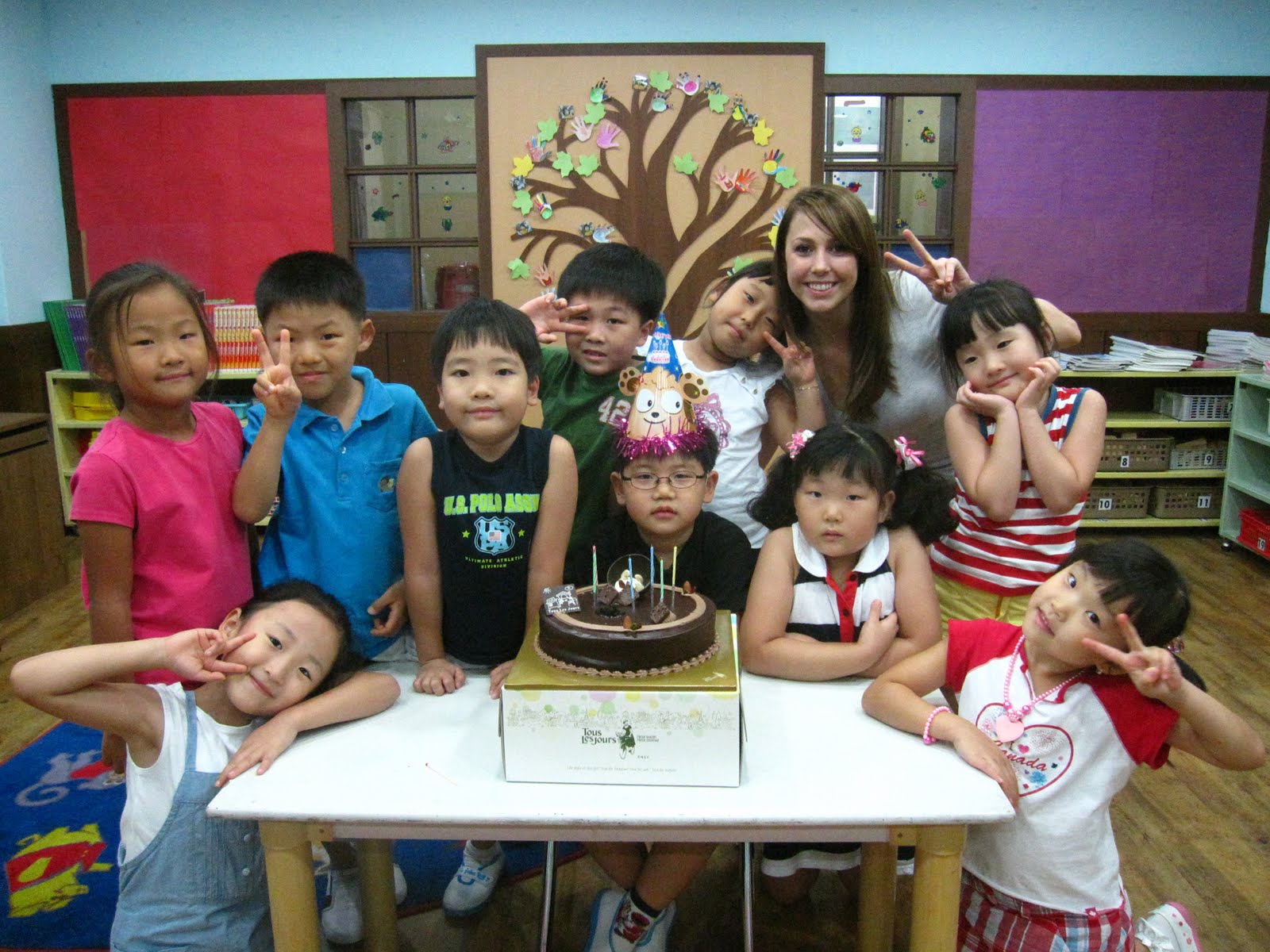
I’ve been here for over two months, so I figure it’s about time I introduce my class and my job at Global Kids International Language School (GKI). I teach at Global Kids International Language School (GKI), a private institute - better known in Korea as a Hagwon (학원) – alongside twenty other native teachers from the US and Canada. As far as hagwons go, GKI is one of the biggest; most other hagwons max out around ten foreign teachers, while others even have as few as one foreigner. (Part of this may be because GKI, with only one other campus in Seoul, is not part of a franchise like many of the hagwons such as LCI or Avalon that have as many as 60 campuses throughout Korea.) Hagwons vary in many other ways as well. I have one friend who only has 4 kids at a time, while I teach an average of 12 students per class. Another friend teaches only elementary and middle school students from 2:30 to 9:30, while I teach both kindergarten and elementary from 10:00 to 7:00 Mondays, Wednesdays, and Fridays, and from 10:00 to 3:30 on Tuesdays and Thursdays with a planning period for kindergarten from 4:50 to 6:20.
All that being said, from what I’ve heard most English hagwons serve the same purpose: to jump-start kids’ English learning at the kindergarten level, or to supplement their Korean-school education with afterschool English classes at the elementary and middle school level. My job here is to aid in both. In the mornings I teach kindergarten and in the afternoon I teach elementary. My mornings are dedicated to phonics, arithmetic, story time, arts and crafts, and silly songs. I’m a “main teacher,” which means I plan lessons and activities around a weekly theme ranging from Atlas of the Earth to Great People of the World, Time and Measuring to Movies and Cartoons, Our Country to Halloween, as well as teach bookwork that is laid out by my supervisor.
On the other hand, in the afternoons on the days that I don’t have kindergarten planning I teach first semester 7 year-olds phonics and vocabulary and fourth semester 10-13 year-olds reading and essay writing. These classes have a completely different feel. For one, unlike kindergarten I spend minimal time with these classes - the 7 year-olds one hour a day, and the 10-13 year-olds 40 minutes 3 days a week – so I haven’t been able to make the same connection with my elementary students as I have my kindies. I also don’t do much planning for these classes. Other than picking out words for spelling tests and grading, I am provided all of my lesson plans. Everything that I teach in the first semester class is handed to me in a minute-by-minute format, more or less outlining what questions I should ask about what page at what time. The fourth semester class is slightly less rigid, but I am still given the worksheets I have to complete with the classes every day, even though I often go beyond what I’m instructed to teach by giving extra essay-writing instruction and extrapolating on the reading topics. Though I don’t do any planning for them, the fourth semester classes require a bit more work outside of school because I have 36 essays to grade 3 times a week…but more on that later.
So, that’s my job in a nutshell. More interesting anecdotes and rants will come with time, but at least for now you get the general idea.
Subscribe to:
Posts (Atom)